Before European immigrants settled in the area that is now Dayton, it was inhabited by Native American tribes. Various tribes lived in or used this area as hunting grounds, including the Miami, Shawnee, Cherokee, Iroquois, and Chickasaw tribes and the Fort Ancient Culture.
Historical accounts indicate that this area was a site of several conflicts between Native Americans and these settlers. A significant attack occurred in 1779, during the American Revolution, when a group of Native Americans killed a large group of men traveling by boats during an expedition as they were camped on a sandbar on the southern side of the Ohio River. This deadly attack became to be known as “Roger’s Defeat” after Capt. David Rogers, who perished in the conflict, and is also known as “the Battle of Dayton, Kentucky.”
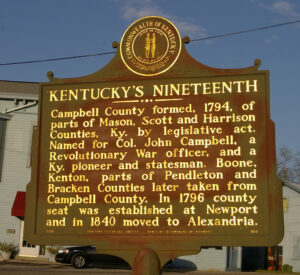 In August 1779, Capt. Rogers, a cousin of famed explorer George Rogers Clark, led a group of about 30 men from Fort Pitt in Pennsylvania to New Orleans to purchase gunpowder and other supplies from the Spanish to be used in the southern campaign of the war. On their return trip, the men were met and joined another group led by Col. John Campbell, for whom Campbell County would later be named.
The combined group of about 70 men and five keelboats continued up the Ohio River when on Oct. 4, 1779, they reached the sandbar, where they decided to camp. While preparing breakfast, the men noticed canoes of Native Americans approaching the sandbar from the Little Miami River across the Ohio River. As these canoes drew closer to the sandbar, more tribesmen revealed themselves from behind trees and other vegetation on and near the sandbar itself and the men quickly came under fire by a war party more than twice their size.
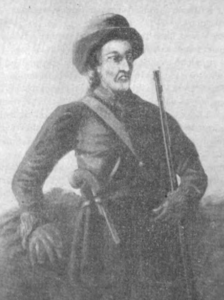
No authentic portrait of Simon Girty is known to exist. This 1905 illustration of Simon Girty is from History of Western Ohio and Auglaize County by C. W. Williamson.
The war party, led by Simon Girty, quickly killed or took prisoner most of the soldiers. Girty, a native of Lancaster County, Pennsylvania, and his brothers, James and George, were captured as children and adopted by Native Americans. During the Revolutionary War, Girty became disillusioned with the Patroit cause and served as an interpreter between the British and their Native American allies. Girty eventually joined a group of renegade Native Americans that terrorized white settlers and Revolutionary soldiers and peddled their scalps to the British for $10 apiece.
With Capt. Rogers’ men outnumbered by more than four to one, the tribesmen killed most of the men in the expedition, including Capt. Rogers, and took many others, including Col. Campbell, a veteran of the Battle of Point Pleasant and other skirmishes, as prisoners. Only about ten men escaped the ambush.
Two of the men who escaped were Basil Brown, who broke both of his arms, and Capt. Robert Benham, who broke both his legs, during the attack. For weeks, the two crippled men, working together to survive, lived in near the area where the deadly battle had been fought, unable to leave until they were rescued in Newport by a passing flatboat. Benham Street in Dayton, the foot of which was near the sandbar, is named after Capt. Benham, as is Benham Street in Newport. Visit this link for more about Capt. Robert Benham background and his ordeal in Dayton, Ky.
Benham returned to the area as a military contractor in 1789. First living in Cincinnati, he later relocated to Newport, where he built his family home next to James Taylor’s home on Second Street. For a time, Benham was a ferry operator, a land agent, justice of the peace, and later, upon relocating again to Cincinnati in 1799, a member of the Ohio Legislature.